
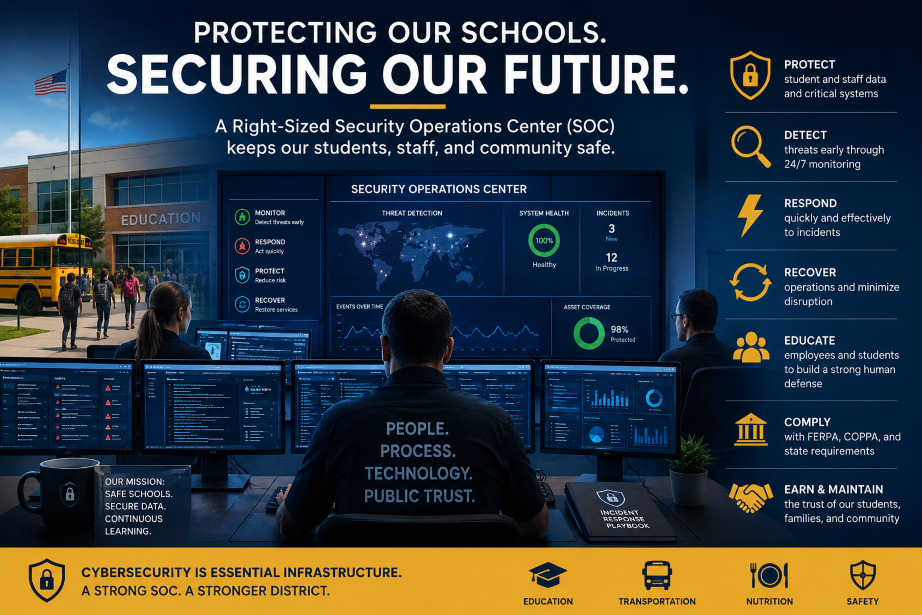
School districts have become prime targets for cybercriminals. Ransomware, phishing attacks, data breaches, and account compromise can disrupt classrooms, delay payroll, expose sensitive student information, and erode public trust. Unlike large enterprises, many districts operate with lean budgets, aging infrastructure, and small IT teams making them attractive targets for opportunistic attackers.
Because of this reality, every school district should establish a right-sized Security Operations Center (SOC) model. A SOC does not need to be a large room with video walls and dozens of analysts. For K-12 education, an effective SOC is a coordinated function of people, processes, and technology focused on protecting learning, operations, and student data.
The Mission of a School District SOC
A SOC is responsible for monitoring, detecting, responding to, and recovering from cybersecurity threats. Its purpose is to reduce operational risk and ensure the continuity of educational services.
For a school district, the SOC should prioritize:
- Protecting student and employee data
- Preventing ransomware and instructional disruptions
- Detecting suspicious activity quickly
- Responding rapidly to incidents
- Supporting safe digital learning environments
- Meeting privacy and regulatory obligations
- Preserving community confidence
Cybersecurity in K-12 is no longer simply an IT issue; it is an operational and leadership responsibility. SOC should be viewed as an operational necessity, much like law enforcement, fire protection, or emergency management.
What a Right-Sized SOC Looks Like
Most school districts do not need a full-scale enterprise SOC. Instead, they need a hybrid model that combines internal ownership with external expertise.
Core Internal Roles
- Superintendent / Board – Strategic support and governance
- Technology Director – Program oversight
- Information Security Officer – Risk management, policy, incident coordination
- Systems / Network Administrator – Infrastructure defense
- Help Desk Team – Escalation and endpoint visibility
- Department Leaders – Business impact decisions during incidents
External Support
- Managed Security Service Provider (MSSP) for 24/7 monitoring
- Incident response retainer
- Cyber insurance contacts
- Legal counsel
- Digital forensics support
- Law enforcement liaison
This hybrid model is cost-effective and realistic; allowing districts to maintain security maturity without building an oversized internal team.
Essential Security Technologies
Rather than chasing expensive tools, districts should prioritize core capabilities that provide visibility and resilience.
Recommended Security Stack
- Next-generation firewall with intrusion prevention
- Endpoint Detection & Response (EDR)
- Multi-Factor Authentication (MFA)
- Centralized log monitoring / SIEM
- Vulnerability scanning
- Email filtering and anti-phishing protection
- Secure backups with offline or immutable copies
- Asset inventory management
- Mobile device management
- Patch management platform
- Remote monitoring and management tools
The objective is straightforward: see threats, stop threats, recover quickly.
High-Priority Systems to Protect
In a school environment, the SOC should closely monitor systems that directly affect students and operations:
- Student Information Systems (SIS)
- Payroll and HR platforms
- Finance / purchasing systems
- Transportation routing systems
- Cafeteria payment systems
- Learning platforms and email systems
- State testing platforms
- Identity and access management systems
- Backup infrastructure
An outage in any of these systems can create district-wide disruption.
Incident Response Readiness
The difference between inconvenience and crisis is often preparation.
Every district should maintain playbooks for:
- Phishing attacks
- Ransomware infections
- Compromised administrator accounts
- Lost or stolen devices
- Vendor breaches
- Student data exposure
- Website defacement
- Denial-of-service attacks
Response Principles
- Detect quickly
- Contain affected systems
- Preserve evidence
- Notify leadership promptly
- Communicate clearly
- Restore operations safely
- Conduct lessons learned reviews
Preparedness reduces downtime, panic, and cost.
Governance and Reporting
A mature SOC should regularly brief district leadership and the board of education using understandable metrics.
Recommended Monthly Reporting
- Security incidents detected and resolved
- Phishing trends and user click rates
- Patch compliance status
- Critical vulnerabilities outstanding
- Backup success rates
- Security training completion rates
- Risk summary and resource needs
Districts should align controls with privacy obligations such as FERPA, COPPA, PPRA and SB 89.
Security Awareness for Employees
For school district, employees are often the first line of defense. Most school district attacks begin with a human click, not a technical exploit.
Training should focus on:
- Recognizing phishing emails
- Strong passwords and MFA usage
- Protecting student records
- Safe use of mobile devices
- Reporting suspicious activity quickly
- Responsible use of cloud tools
Short, frequent awareness campaigns are more effective than annual checkbox training.
Budget Reality: Start Smart, Scale Over Time
A strong SOC does not require an unlimited budget. Many districts can significantly improve security by focusing first on:
- MFA everywhere possible
- Reliable backups
- Endpoint detection
- Security awareness training
- Vulnerability management
- External monitoring support
Security maturity should be built in phases, aligned to risk and available funding.
My Final Thoughts
For a school district, the best SOC is not the biggest; it is the one that is sustainable, disciplined, and responsive.
Families trust schools with their children’s education, records, transportation, nutrition services, and daily safety. Protecting those services now includes cybersecurity.
A right-sized SOC helps defend learning, safeguard public trust, and ensure resilience in an increasingly digital world. For modern school districts, cybersecurity is no longer optional infrastructure, it is essential infrastructure.