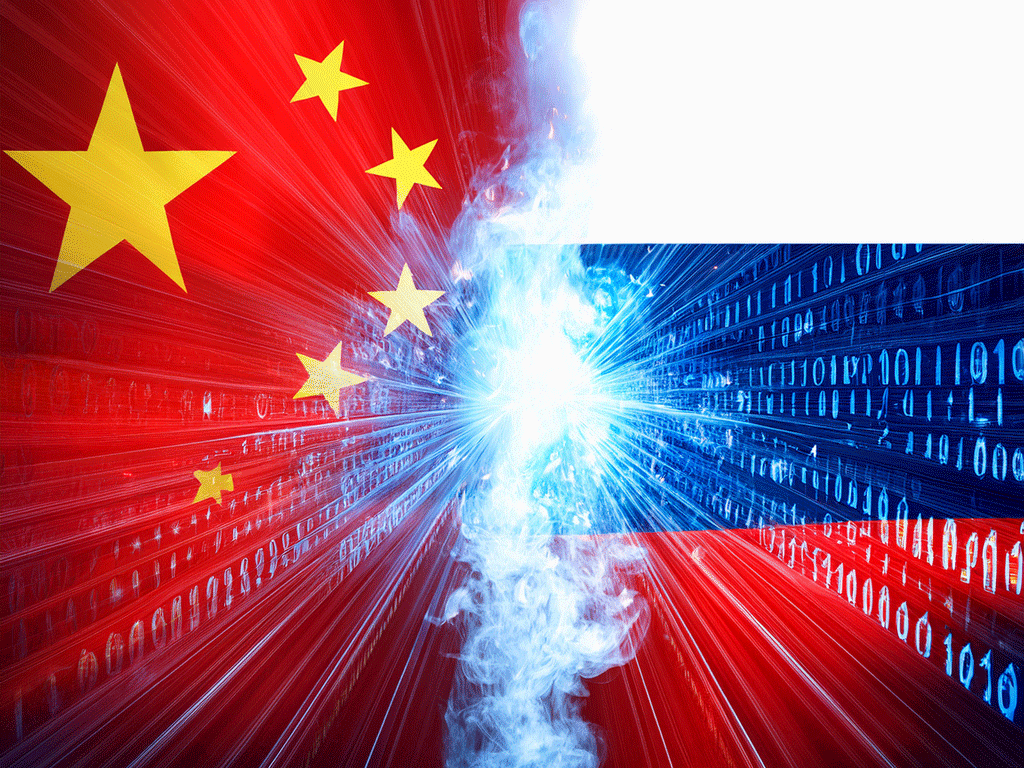
Advanced Persistent Threats (APTs) represent the apex of modern cyber adversaries, stealthy, resource-rich, and strategically focused. Over the past decade, these nation-state–aligned actors have evolved from simple network intrusions into multi-stage campaigns capable of compromising software supply chains, critical infrastructure, and national defense assets. This article dissects major state-sponsored campaigns against U.S. interests, analyzes their technical characteristics, and explores the cascading effects on government operations, private industry, and citizen data security.⚙️The Evolution of APT Operations
The concept of an APT originated in the early 2000s within the U.S. Air Force to describe sustained intrusions that evaded traditional perimeter defenses. Unlike criminal ransomware operators seeking immediate profit, APTs pursue strategic intelligence: classified data, intellectual property, and control of critical systems.
Their distinguishing characteristics include:
- Persistent access: Long-term footholds maintained through multiple redundant backdoors and privilege escalation.
- Customized toolchains: Custom malware frameworks, often modular, with command-and-control (C2) obfuscation and encrypted communications.
- Lateral movement & data staging: Systematic credential harvesting (via Mimikatz or LSASS dumps), Active Directory enumeration, and exfiltration over covert channels such as HTTPS, DNS tunneling, or cloud storage APIs.
- Zero-day exploitation: Rapid weaponization of newly discovered vulnerabilities before public disclosure or patch availability.
By combining these techniques with patient reconnaissance, state-sponsored actors transform enterprise networks into intelligence collection platforms.
🧩Case Studies: High-Impact State-Sponsored Intrusions
🧠SolarWinds / APT29 (Russia)
— Supply Chain as a Weapon
In December 2020, FireEye (now Mandiant) uncovered a widespread supply-chain compromise within SolarWinds Orion, a network management product deployed across U.S. federal agencies and Fortune 500 enterprises.
The malicious component, SUNBURST, was a digitally signed DLL update that established C2 channels over HTTP(S), performing system reconnaissance and selectively activating second-stage payloads. Forensic evidence attributed the operation to APT29 (Cozy Bear), associated with the Russian Foreign Intelligence Service (SVR).
Technical hallmark: Use of trusted software updates to evade perimeter controls, digitally signed binaries, and domain fronting for C2 evasion.Impact: Breach of the U.S. Departments of Treasury, Commerce, DHS, and major private firms, illustrating the fragility of software supply-chain trust models.💬Microsoft Exchange / HAFNIUM (China)
— Zero-Day Mass Exploitation
In early 2021, Microsoft disclosed exploitation of four zero-day vulnerabilities (CVE-2021-26855 et al.) within on-premises Exchange Server. The campaign, attributed to a China-based APT codenamed HAFNIUM, executed server-side request forgery (SSRF) and remote code execution to implant web shells such as China Chopper for persistent access.
Technical hallmark: Chain exploitation—leveraging multiple vulnerabilities to bypass authentication, execute arbitrary code, and establish long-term footholds.Impact: Tens of thousands of organizations compromised globally; massive credential theft and email exfiltration; emergency response from CISA and the White House.🧾OPM Data Breach (China)
— Human Intelligence Exploitation
Between 2014 and 2015, APT actors exfiltrated over 21 million personnel records from the U.S. Office of Personnel Management (OPM), including SF-86 forms, fingerprints, and background investigations. This data provided unparalleled visibility into federal employees, contractors, and security clearance holders—an intelligence goldmine for human targeting.
Technical hallmark: Slow lateral movement, minimal noise, use of legitimate credentials, and encrypted exfiltration over HTTPS to remote servers.Impact: Long-term national security exposure; potential leverage over federal employees and intelligence officers.🗳️DNC / GRU (Russia)
— Cyber Influence Operations
The 2016 DNC intrusion, attributed to APT28 (Fancy Bear), demonstrated cyber-enabled information warfare. Attackers used spear-phishing and malware implants (X-Agent, Sofacy) to extract and leak politically sensitive communications.
Technical hallmark: Blending cyber espionage with psychological operations (PsyOps) through timed data leaks and disinformation campaigns.Impact: Direct interference in democratic processes; erosion of trust in digital political infrastructure.⚡ Critical Infrastructure Attacks (Iran, North Korea)
Iranian-linked APTs such as APT33 (Elfin) and APT34 (OilRig) have targeted energy sector entities with credential-harvesting campaigns leveraging PowerShell scripts and WMI persistence. North Korea’s Lazarus Group, responsible for WannaCry (2017) and multiple financial heists, uses cybercrime to fund sanctioned regimes.
Impact: Operational disruption (e.g., Colonial Pipeline, 2021), economic instability, and increased geopolitical tension.🧬Technical Patterns Across Campaigns
Despite varied motivations, state-sponsored APTs share common operational frameworks:
| Phase | Typical Tactics & Techniques (MITRE ATT&CK) |
| Initial Access | Spear-phishing (T1566), Supply-chain compromise (T1195), Exploit public-facing applications (T1190) |
| Execution | Command-line interface (T1059), Scripting (PowerShell, Python) |
| Persistence | Registry Run Keys (T1060), Scheduled Tasks (T1053), Web Shells |
| Privilege Escalation | Token manipulation (T1134), Exploitation for privilege escalation (T1068) |
| Defense Evasion | Obfuscated files, timestomping, encrypted communications |
| Credential Access | LSASS memory dumps, NTDS.dit extraction, Kerberoasting |
| Exfiltration | Encrypted HTTPS, cloud storage abuse, exfiltration to third-party C2 domains |
| Command & Control | Domain fronting, CDN abuse, fast-flux DNS, covert channels over legitimate protocols |
These tactics demonstrate mature tradecraft designed to blend into enterprise network noise and defeat conventional intrusion detection.
🏭Societal & Economic Implications
The consequences of state-sponsored cyber operations extend beyond the network perimeter:
- Data Sovereignty & Privacy: Breaches such as OPM and Equifax (though the latter is criminally motivated) highlight how stolen personal data fuels long-term espionage and identity theft.
- Supply Chain Integrity: SolarWinds underscored that every vendor dependency is a potential threat vector.
- Critical Infrastructure Exposure: Attacks against pipelines, hospitals, and utilities demonstrate kinetic consequences of cyber sabotage.
- Geopolitical Leverage: Cyber operations are now instruments of statecraft—less costly than kinetic warfare, but capable of equivalent disruption.
🛡️Countermeasures & Strategic Response
🧰Enterprise Technical Controls
- Zero Trust Architectures: Continuous authentication, micro-segmentation, and identity-based access control reduce lateral movement.
- Threat Hunting and EDR/XDR Integration: Detect anomalous persistence mechanisms, registry manipulation, and C2 activity.
- Software Supply Chain Auditing: Implement SBOM (Software Bill of Materials) and code-signing verification pipelines.
- Patch Cadence Acceleration: Reduce mean time to patch (MTTP) via automated vulnerability management and out-of-band updates.
🏛️ Government and Policy Actions
- CISA’s “Shields Up” Initiative emphasizes real-time intelligence sharing across sectors.
- Mandatory Incident Reporting (CIRCIA) will enhance collective situational awareness.
- International Norms: Continued cooperation through frameworks like the Budapest Convention and U.S.–EU cyber dialogues.
🚀Conclusion
“Advanced Persistent Threats are not transient digital nuisances, they are strategic instruments of national power,“
Their convergence of technical precision and geopolitical intent has redefined the cybersecurity landscape. Defending against these adversaries requires not only endpoint hardening and intrusion detection but also policy alignment, intelligence fusion, and supply-chain transparency.
“the front lines of cyber conflict now extend into every data center, every cloud tenant, and every software vendor upon which American infrastructure relies.”
The nation’s digital resilience will depend on sustained collaboration between government, private industry, and the research community—where threat intelligence, rapid response, and architectural modernization form the triad of defense against persistent, state-sponsored adversaries.